
Goods & Services
Access to basic goods and services, whether health care, groceries, or community facilities, should be available to all people, whether they have access to a personal vehicle or not. Incomplete sidewalks, a lack of dedicated bicycle facilities, and limited transit service can present barriers.
For this analysis, we considered access to hospitals, clinics, and pharmacies; grocery stores; and community centers, municipal halls, post offices and libraries. We identified barriers to access related to bus service and walking and bicycling infrastructure. See our Methodology document for more information, and our Barriers to Basic Needs Map for details.
Health Care (Hospitals, Clinics, & Pharmacies)
There are three hospitals in Dutchess County: Northern Dutchess Hospital, Mid-Hudson Regional Hospital, and Vassar Brothers Medical Center. For clinics, we focused on urgent care facilities and other clinics that serve outpatients without an appointment; there are 20 of these clinics in Dutchess County. We also evaluated 41 pharmacies, including those at hospitals and in large grocery stores. Overall, about 15 percent of county residents live within a half-mile of a hospital, clinic, or pharmacy.
OTHER HOSPITALS SERVING OUR RESIDENTS
The Castle Point VA Medical Center, located in Fishkill, serves veterans and has bus access via County Public Transit’s Route B. And Sharon Hospital in Connecticut, located east of Millerton and North East, serves many northeast Dutchess residents. The Northeast Community Center’s Northeast Dutchess Transit program provides trips to the hospital.
How walkable are the areas around health care facilities?
While people needing medical attention may not walk to a hospital, staff, visitors, and some patients may, if it’s safe and feasible. Similarly, sidewalk access to clinics and pharmacies allows shorter trips to be made by walking.
The Vassar Brothers and Mid-Hudson Regional hospitals have good sidewalk coverage within a half mile. The area around Northern Dutchess Hospital has more limited sidewalk connections but is still moderately walkable.
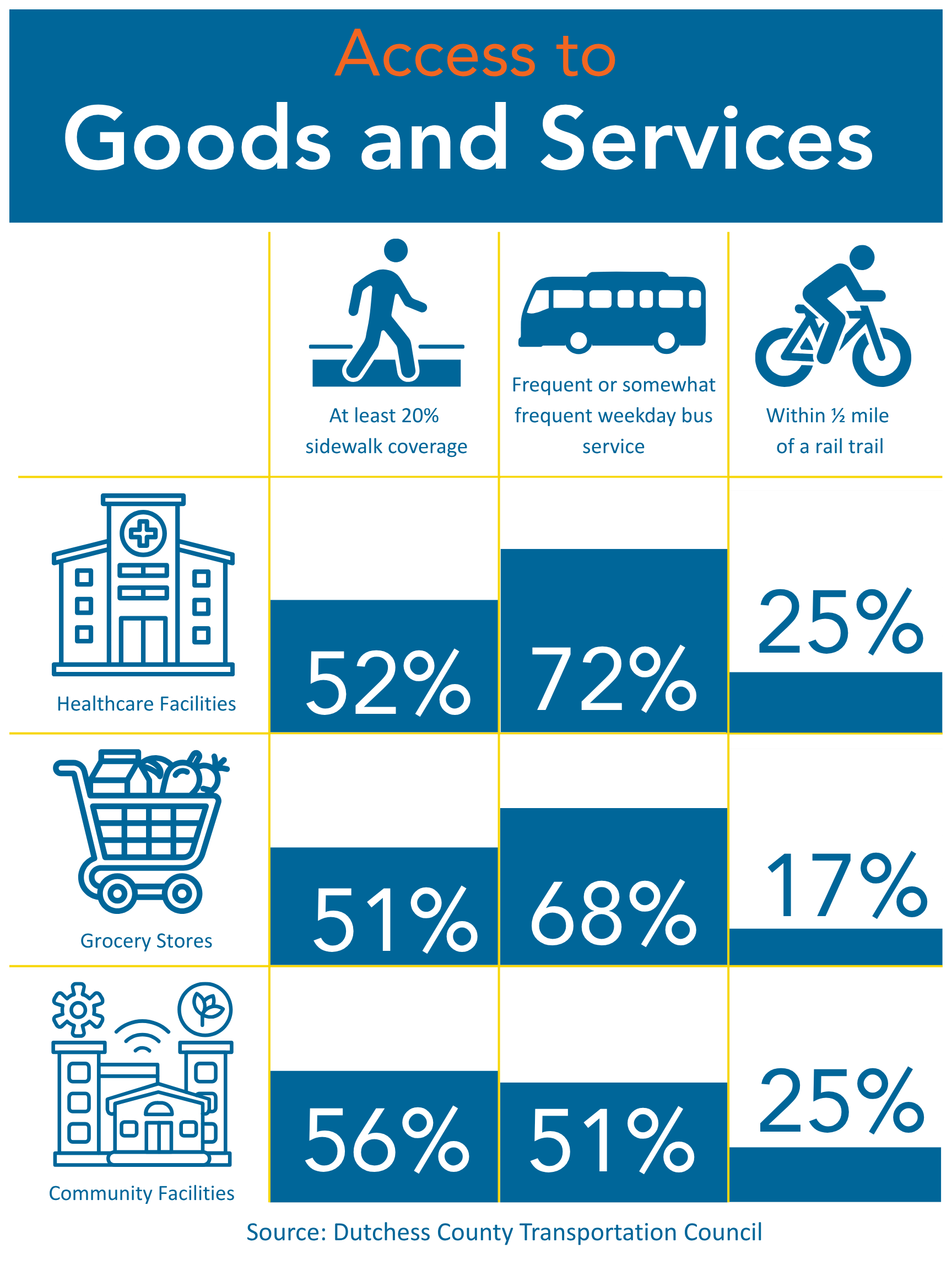
About half of the clinics and pharmacies are generally walkable (with at least 20 percent sidewalk coverage, which in our analysis reflects decent walkability). This includes locations in our cities, villages, and town centers. A quarter of clinics and pharmacies have either no sidewalks at all or less than 10 percent sidewalk coverage, which in most cases makes walking infeasible. The remaining locations (with between 10 and 20 percent coverage) are somewhat walkable but could benefit from improvements.
How frequent is bus services to health care facilities?
Bus access can provide transportation options for health care clients and staff as well as hospital visitors. However, given that medical visits often occur during off-peak times and many health care workers have non-traditional schedules, it can be difficult to align the timing of health care trips with bus schedules.
Nearly half of the health care facilities have frequent weekday bus service. This includes the Vassar Brothers and Mid-Hudson Regional hospitals, half of the clinics, and about 40 percent of the pharmacies. Another quarter of facilities have somewhat frequent service, including Northern Dutchess Hospital. 15 percent have infrequent service and 13 percent have no weekday service.
On Saturdays, bus service is slightly less; on Sundays, only one facility has frequent service – the Sun River Health Clinic in Beacon – and more than half the health care facilities have no service.
How many health care facilities have access to a rail trail?
Rail trail access to hospitals, clinics, and pharmacies can provide a safe and healthy transportation option for staff to get to work, clients to access a doctor, and people to pick up a prescription.
About 25 percent of the health care facilities (15 total) are near a rail trail. This includes several facilities near the Dutchess Rail Trail in the City and Town of Poughkeepsie, as well as a pharmacy in Millerton and clinic in Amenia near the Harlem Valley Rail Trail. But aside from the Mid-Hudson Regional Hospital in Poughkeepsie (which also includes a pharmacy and various medical offices) and the Stop & Shop pharmacy in Arlington, none of these facilities have a designated on- or off-street connection to the trail.
What We Heard
“I mostly drive everywhere, but it would be nice to know I could use the bus if necessary, because sometimes I’m stuck at home without a car. In the back of my mind, I worry that I might need to get to the doctor’s office or a hospital for me or my daughter, but it might not be a situation that warrants the cost of an ambulance.”– Moving Dutchess Forward survey
Grocery Stores
There are 36 grocery stores in Dutchess County. Sidewalk, bus, and bicycle access to these stores is particularly important for people without a car, including those who cannot or choose not to drive. 10 percent of county residents live within a half-mile of a grocery store.
How walkable are the areas around grocery stores?
More than half of grocery stores are in walkable locations (with at least 20 percent sidewalk coverage). This includes stores in our cities, villages, and town centers. But about 30 percent of grocery stores have either no sidewalks at all or less than 10 percent coverage, which in most cases makes walking infeasible. The remaining stores are somewhat walkable but could benefit from improvements. Additionally, many stores lack sidewalk connections from the main access road, making it inconvenient or even unsafe to walk to the entrance.
How frequent is bus service to grocery stores?
Two-thirds of the grocery stores have either frequent or somewhat frequent transit service on weekdays. However, seven stores have infrequent service, and 14 have no weekday service. Saturday service is similar, but Sunday service is more limited – only one store has frequent service and more than half of the stores have no service.
In addition, County Public Transit riders are limited to four bags, which can make it harder to use the bus for grocery shopping. Shoppers without access to a vehicle must then rely on friends or ride-hailing services like taxis or Uber/Lyft.
OTHER FOOD RESOURCES
In addition to large grocery stores, smaller food stores, farmers markets, food pantries, and meal programs help fill gaps in food access.
Dutchess is home to more than ten farmers markets, which offer fresh produce and prepared foods. Most are seasonal and operate once a week. Farmers markets typically accept SNAP benefits, and some participate in other programs to assist lower-income shoppers.
There are also more than 70 food banks in Dutchess County, with at least one in most of our municipalities. Days and hours of service vary, and some are by appointment only.
How many grocery stores have access to a rail trail?
Six grocery stores are near a rail trail. However, proximity does not ensure access. The Tri Corner F.E.E.D. Market in Millerton and the Stop & Shop in Arlington have relatively direct access. On the other hand, Adams in Arlington and the Acme Market and Berry’s Farm in Hopewell Junction are near a rail trail but separated by busy State roads. The Shop Rite in northern Poughkeepsie is extremely close to the Northside Line, but a formal connection has not yet been made.
Community Facilities
Community facilities provide a location to gather and socialize, learn something new, and access essential services. For our analysis, we focused on the 16 community centers, 24 public libraries, 30 town, village, and city halls, and 38 post offices in Dutchess County. These facilities are often central to the community, both geographically and functionally. The programs and services offered fulfill basic needs for people of all ages. But some patrons may be too young or too old to drive, making safe and convenient access by walking, bicycling, and transit more important. Nearly 20 percent of county residents live within a half-mile of a community facility.
What We Heard
“Teens, seniors, and those that don’t drive or have cars need to be able to get to shops, village and town halls, doctors, libraries, and community centers, as well as between villages.” – Moving Dutchess Forward survey
How walkable area the areas around community facilities?
Most of the community centers are at least moderately walkable (with over 20 percent sidewalk coverage), particularly in cities or village centers. Those in more rural and suburban locations, such as the towns of Amenia, Beekman, East Fishkill, Fishkill, Poughkeepsie, and Union Vale, are less walkable. The Red Hook community center also has few sidewalks, despite its location within the village.
Sidewalk access to municipal halls varies and generally reflects the walkability of the overall community. Almost two-thirds are decently walkable, including the two city halls, eight village halls, and nine town halls located within villages or hamlets. A few have no sidewalk access, such as in Clinton, Dover, Milan, Pine Plains, and Stanford. The remaining municipal halls have less than 20 percent sidewalk coverage and would benefit from improved sidewalk connections.
Many libraries are decently walkable, but sidewalk coverage varies. Libraries with good walkability are in our two cities, most villages, and five towns. Six libraries have no sidewalks at all: Boardman in Poughkeepsie, and the Beekman, Dover Plains, Staatsburg, Clinton, and Stanford libraries. The rest are moderately walkable, but connections to surrounding areas could be improved.
Sidewalk access to post offices also varies. About half of post offices have good walkability, including those in our cities, villages, and the towns of Amenia, LaGrange, Pine Plains, Pleasant Valley, and Poughkeepsie. But almost as many have no sidewalks or very minimal coverage—these are in rural areas and small hamlets like Billings, Chelsea, Holmes, and Salt Point. The remaining five (Hopewell Junction, Dover Plains, Hyde Park, Annandale, and Wassaic) are somewhat walkable and would benefit from additional sidewalk connections.
How frequent is bus service to community facilities?
Transit access to community facilities tends to follow a consistent pattern: on weekdays, locations in southwestern Dutchess have frequent service; locations in village and town centers in western Dutchess have somewhat frequent service; villages and more suburban locations in southern Dutchess have infrequent service; and rural areas have no service. Saturday service is slightly less, while Sunday service is mostly infrequent or not present.
How many community facilities have access to a rail trail?
A quarter of our community facilities are near a rail trail. These include facilities near the Dutchess Rail Trail in Poughkeepsie and Hopewell Junction, along the Harlem Valley Rail Trail in Millerton, Amenia, and Wassaic, and near the Maybrook Trailway in Stormville and Pawling.
However, in most of these locations, a connection to the trail (via an on-street facility or an off-street path) has not been created. Improving trail connections to these nearby facilities would improve walking and bicycling access.
Our Role
Based on this analysis, our role could include the following:
- Improve sidewalk access to health care, grocery stores, and community facilities, particularly in somewhat walkable areas such as rural hamlets and suburban town centers where additional connections could make walking a feasible option.
- Work with County Public Transit to improve transit service to health care, grocery stores, and community facilities. Use access to basic needs as a key criterion when choosing where to provide or extend service. Consider alternate transit models for access to these destinations when fixed-route service is not feasible.
- Improve bicycle access to health care, grocery stores, and community facilities. Work with municipalities, road and property owners, and other partners to provide designated on- or off-street connections to key destinations.